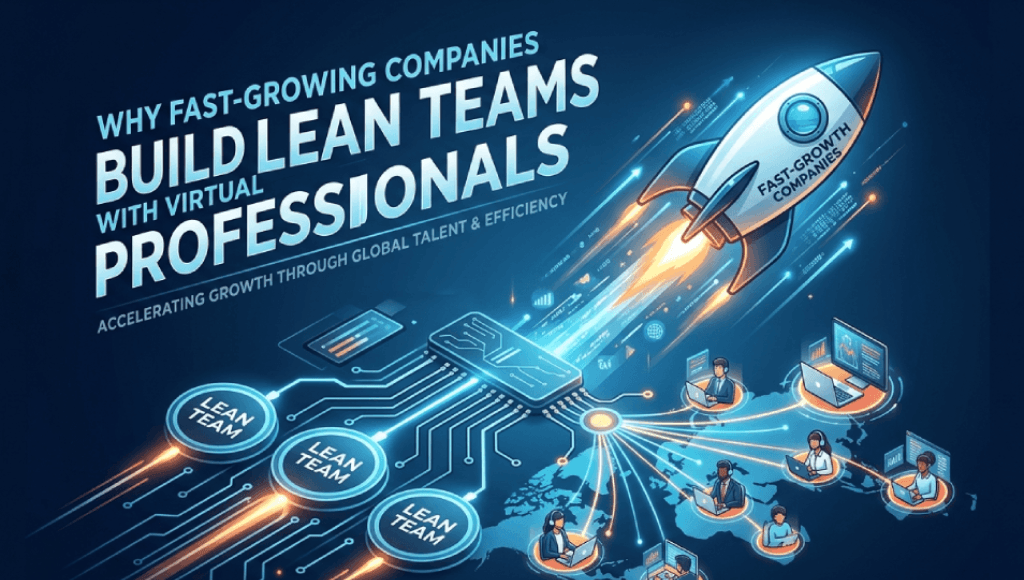
Business growth does not always require building a large internal workforce. In fact, many successful companies today are choosing a very different path. Instead of rapidly expanding full-time in-house teams, they are building lean organizations supported by skilled virtual professionals.
This approach allows businesses to remain agile, efficient, and financially flexible while still accessing the support needed to grow. Lean teams are not about doing less—they are about operating smarter. By combining strong leadership with specialized remote support, businesses can scale faster while keeping operations streamlined.
What Is a Lean Team?
A lean team is a business structure built around efficiency, clear responsibility, and smart resource allocation. Rather than hiring large numbers of employees for every function, companies maintain a focused core team and add specialized support where needed.
This creates a flexible operating model that reduces complexity while improving performance. Lean teams focus on results, productivity, and efficient systems rather than headcount size.
Lower Operational Overhead
Traditional expansion often increases costs quickly. Office space, equipment, employee benefits, onboarding expenses, and administrative management all add financial pressure.
Virtual professionals reduce much of this overhead. Businesses can gain operational support without increasing office infrastructure, allowing budgets to be invested more strategically in growth initiatives.
Access to Specialized Talent
Fast-growing businesses need different skills at different stages. One period may require administrative coordination. Another may need customer support, research assistance, content preparation, operations help, or technical support.
Virtual professionals provide flexible access to specialized expertise exactly when it is needed. This allows businesses to build capability without unnecessary long-term staffing commitments.
Improved Agility
Markets change quickly. Customer demand changes, priorities shift, and businesses must adapt faster than ever before. Large internal structures can sometimes slow decision-making and reduce flexibility.
Lean teams supported by virtual professionals can adapt quickly. Businesses can expand support in one area, reduce activity in another, and reorganize workflows with far greater ease.
Leadership Focuses on High-Value Work
One major advantage of lean business structures is that leadership spends less time managing unnecessary complexity. With operational support distributed properly, leaders can focus on partnerships, innovation, customer strategy, and long-term planning.
This shift improves business direction and creates stronger decision-making capacity.
Better Productivity Through Clear Roles
Lean teams often perform well because responsibilities are clearly defined. Each team member focuses on high-impact work, while operational tasks are assigned to professionals best suited for them.
This reduces confusion, improves accountability, and creates smoother workflows across departments.
Scalable Without Heavy Risk
Growth always involves uncertainty. Businesses may hesitate to hire large full-time teams because future workload is difficult to predict.
Virtual professionals make scaling more manageable. Businesses can expand support based on real operational demand rather than making large fixed hiring commitments too early.
Stronger Process Development
Lean businesses often rely on systems, documentation, and structured workflows to maintain efficiency. Virtual professionals can help organize these processes, update documentation, manage scheduling systems, and support operational consistency.
Well-built processes create long-term stability and make future growth easier to manage.
Supporting Global Business Operations
For companies serving clients across multiple regions, virtual professionals provide broader operational coverage. Different time zones, extended working hours, and international communication support become easier to manage.
This improves service responsiveness and strengthens customer relationships globally.
Building a Smarter Growth Model
Fast growth is exciting, but unmanaged growth creates operational problems. Lean teams help businesses grow strategically by adding capability carefully, maintaining financial discipline, and building strong operational foundations.
This creates healthier long-term expansion rather than growth built on operational strain.
The most successful modern businesses are not always the biggest—they are often the smartest in how they build teams. Lean organizations supported by skilled virtual professionals operate efficiently, adapt quickly, and scale with greater confidence.
By staying focused, flexible, and strategically supported, businesses create stronger foundations for sustainable growth in an increasingly competitive market.